Rethinking Trans-Saharan Africa
Collaboration, Scale, and Structural Transformation
A vision of complementary regional hubs that connect African capabilities, resources and people into shared systems of production.
Introduction: Unrealized Possibilities
When the world turned its attention to the Artemis II mission, it represented more than a technological milestone. It demonstrated what coordinated investment, long-term vision, and institutional alignment can achieve at scale. Though led by NASA, the mission drew on contributions from multiple countries, reflecting a system where knowledge, resources, and expertise are pooled across borders to produce outcomes no single nation could achieve alone.
Moments like these resonate globally, including in Africa, where gestures such as that of Christina Koch, who highlighted her academic ties to Ghana, are celebrated as symbols of connection to global progress.
Yet, while such moments inspire pride, they also reveal a deeper reality. Africa’s presence in these achievements remains largely symbolic, rather than rooted in coordinated systems that contribute directly to their realization.
It is not difficult to imagine a future where such moments are not observed from afar, but actively shaped by African countries. A future in which research centers, manufacturing systems, and technological institutions across the continent contribute to global advancements in aerospace, artificial intelligence, energy systems, and advanced medicine. Yet, this possibility remains largely unrealized.
Africa possesses immense potential across multiple sectors, including education, infrastructure, governance, and technology. The continent is rich in both human capital and natural resources. Yet, despite these advantages, a significant proportion of its population continues to live in poverty, with limited access to basic services and economic opportunities (See Figure 2). This contradiction is not merely developmental; it is systemic. A reflection of a deeper issue rooted in how Africa is organized, how it interacts internally, and how it is positioned within the global system. In Trans-Saharan Africa in particular, the challenge is not simply a lack of resources or ambition, but a persistent lack of coordination at scale.
This disparity is also a reflection of uneven access to development itself. The need for Africa to “catch up” is therefore not about comparison with other regions, but about addressing this persistent inequality and expanding access to dignity and opportunity. Bridging this divide will require more than incremental progress but a fundamental rethinking of how development is pursued across the continent.
Africa Before Colonization: Systems Without Scale
Much of Trans-Saharan Africa historically existed within a political landscape that was largely fragmented (See Figure 3). However, large centralized empires such as the Mali Empire, Ethiopian Empire, and Songhai Empire among others demonstrate that advanced systems of governance, long-distance trade, and cultural exchange were already well established. These empires supported regional connectivity through organized administration and extensive trade networks linking West Africa to North Africa and beyond.
Across these networks, goods, people, and ideas circulated across vast distances, creating zones of economic and cultural interaction. As a result, parts of the region were deeply interconnected, with certain areas functioning as centers of power and coordination. However, this connectivity was uneven. While strong regional systems existed, broader structural unity remained limited.
Africa therefore entered the modern era not as a single integrated system, but as a collection of interconnected yet largely autonomous regions
Across much of Sub-Saharan Africa, political life was organized at a more localized level. Many societies were structured around small communities, clans, and tribes, with leadership rooted in lineage and customary authority. Boundaries were often flexible and overlapping, and power was shared across elders, chiefs, and local leaders rather than concentrated in a single centralized authority.
Colonization did not create this fragmentation from nothing. It intervened in this uneven landscape and transformed it, converting flexible systems into rigid territorial units and reinforcing divisions that had previously been more fluid.
The Scramble for Africa: Foundations of Structural Constraints
The Scramble for Africa, formalized during the Berlin Conference of 1884 to 1885, imposed rigid territorial boundaries that prioritized extraction over cohesion. European powers partitioned the continent into colonial territories that later became the borders of modern African states, with little regard for existing social, economic, or cultural systems.
These boundaries were not designed to support integrated economic systems. Instead, they were structured to facilitate control and the outward flow of resources. As a result, territories with significantly different ecological and economic conditions were reorganized into unequal political units. Some countries inherited access to coastlines, established trade corridors, and fertile land, positioning them more favorably within emerging global markets. Others became landlocked, with limited access to international trade while several regions were left with arid environments and less productive soils that constrained agricultural development.
These borders institutionalized fragmentation by locking diverse regions into separate political systems, each expected to function as an independent economy within a global system that rewards scale, integration, and industrial capacity.
Although formal colonial rule ended, its underlying logic persisted. Contemporary global systems continue to reflect patterns of extraction and imbalance established during that period, constraining the ability of African states to industrialize independently and participate fully in higher-value segments of the global economy.
The Case for Intercontinental Collaboration
The modern global economy is increasingly organized around networks, regional blocs, and coordinated systems rather than isolated national economies. In this context, scale, integration, and institutional alignment are central to competitiveness.
The European Union demonstrates how historically fragmented regions can achieve integration through shared markets, regulatory systems, and the free movement of goods, capital, and people.
Similarly, the Association of Southeast Asian Nations (ASEAN) has enabled Southeast Asian economies to position themselves collectively within global production networks, allowing smaller states to overcome structural limitations through coordinated participation.
China’s development trajectory further demonstrates the importance of scale and coordination. By concentrating investment in specific regions (See Figure 7), it developed industrial zones and infrastructure corridors that became centers of manufacturing and innovation, with growth gradually spreading across the broader economy.
In contrast, Trans-Saharan Africa remains divided into multiple national economies constrained in size, capital, and technological capacity. This fragmentation limits participation in capital-intensive and knowledge-driven sectors such as advanced manufacturing industries, artificial intelligence, aerospace, semiconductor fabrication, nuclear energy, and advanced medicine.
Collectively, however, the continent possesses the scale, resource base, and human capital needed to engage in these industries, provided these capacities are coordinated rather than dispersed.
System Building: From Dependence to Production
A major limitation of past development approaches in Africa has been the emphasis on financial flows, including aid, loans, and short-term capital, rather than long-term structural transformation. While such interventions may provide temporary relief, they often fail to address the underlying constraints that limit productive capacity.
Sustainable development is rooted in systems. Infrastructure, skills, and institutions form the foundation for economic growth and diversification. Railways, energy systems, universities, research institutions, and digital networks are not merely physical or social investments; they enable production, support innovation, and facilitate the movement of goods, people, and knowledge.
An example of this development model can be seen in post-World War II Europe, where recovery was driven by coordinated investment in infrastructure, industry, and institutions, enabling rapid industrialization. The Marshall Plan (See Figure 8), officially the European Recovery Program (ERP), initiated in 1948, was a U.S.-led effort that provided over $13 billion ($150+ billion in 2025 money) for rebuilding Western Europe after the war.
In contrast, many African economies remain positioned within global value chains as exporters of raw materials and importers of finished goods, limiting value addition and constraining industrial growth.
Meaningful collaboration must therefore shift focus from short-term financial inputs to long-term system building. This includes sustained investment in infrastructure, deliberate strategies for skills development and knowledge transfer, and stronger institutional coordination across countries to support integrated and productive economic systems.
Reimagining Africa Through Regional Hubs
Africa does not need to redraw its political borders, but it must rethink how it organizes its productive capabilities. The central challenge is not only fragmentation, but limited participation in advanced industries.
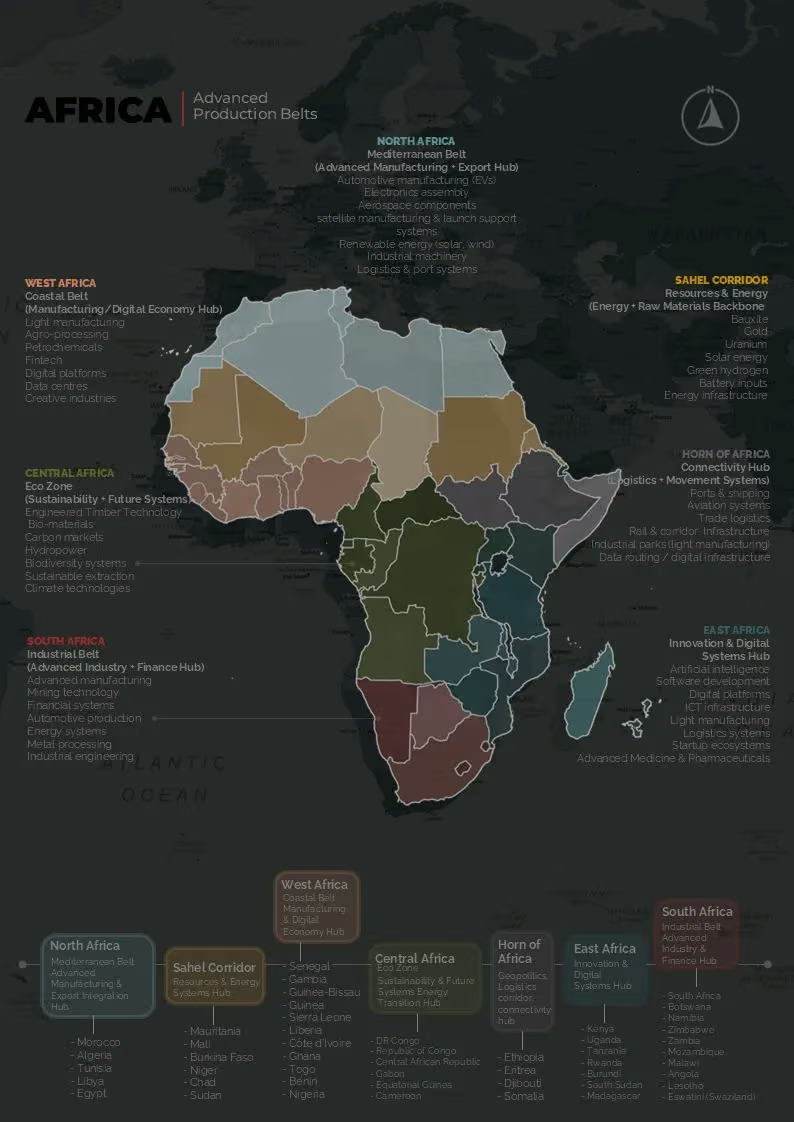
A more effective approach is regional specialization through interconnected production hubs, where different parts of the continent focus on specific segments of these industries (See Figure 9).
A West Africa Coastal Belt, anchored by major port cities and dense urban markets, can function as a manufacturing and consumption base, supporting light industry, petrochemicals, fintech, and digital platforms.
The Sahel Corridor, with its vast solar potential and mineral resources, can serve as an energy and input base, supplying the power and materials required for industrial systems across the continent.
The North Africa Mediterranean Belt, positioned close to European markets and supported by an existing industrial base, can function as Africa’s export and advanced manufacturing interface, supporting automotive, electronics, aerospace, renewable energy and satellite manufacturing & launch support systems .
The Central Africa Eco Zone, anchored by the Congo Basin, can serve as a sustainability core, supporting hydropower, bio-materials, and climate systems essential for long-term development.
The Horn of Africa, located along major global shipping routes, can operate as a logistics and connectivity corridor, linking inland production systems to international markets.
An East Africa Systems and Innovation Belt, supported by expanding urban centers and digital ecosystems, can drive artificial intelligence, digital platforms, and advanced medicine.
In Southern Africa, existing industrial capacity, infrastructure, and financial systems provide a foundation for scaling advanced manufacturing, engineering, and high-value production..
Together, these hubs form a coordinated system in which regions contribute complementary capabilities within shared value chains, enabling participation in advanced sectors such as semiconductors, aerospace, pharmaceuticals, and high-technology infrastructure.
Integration, in this context, is not about uniform development, but about coordinated participation in advanced systems of production.
Enabling Coordination: Mobility, Finance, and Institutions
Africa already possesses a wide network of regional institutions designed to promote integration (See Figure 10). Beyond the African Union (AU), several Regional Economic Communities (RECs) such as Economic Community of West African States (ECOWAS), the Southern African Development Community (SADC), the East African Community (EAC), the Common Market for Eastern and Southern Africa (COMESA), could serve as building blocks for continental coordination.
In addition, sub-regional monetary and economic unions such as the West African Economic and Monetary Union (WAEMU/UEMOA) and the Economic and Monetary Community of Central Africa (CEMAC) demonstrate that deeper forms of economic coordination, including shared currencies and monetary policy, are already achievable within smaller blocs.
At the continental level, the African Continental Free Trade Area (AfCFTA) represents a significant step toward creating a unified market for goods and services across Africa.
Despite these extensive institutional frameworks, integration remains limited in practice. Many of these organizations operate in parallel with overlapping mandates, weak enforcement mechanisms, and limited coordination across regions. As a result, their collective potential to support large-scale economic transformation remains underutilized.
For the proposed model of specialization and collaboration to succeed, these institutions must be strengthened and better aligned within a coherent continental strategy. Central to this effort is improving mobility across the continent. The movement of students, professionals, researchers, and entrepreneurs remains constrained by visa restrictions, regulatory barriers, and fragmented systems. Enabling the free or simplified movement of talent would allow skills and knowledge to circulate more effectively, supporting the development of specialized hubs and the diffusion of expertise across regions.
In parallel, greater coordination of monetary systems would be essential. The existence of multiple currencies with varying levels of stability continues to limit intra-African trade and complicate cross-border investment.
Building on existing monetary unions, there is potential to develop coordinated financial mechanisms or a continental trade currency, not to replace national currencies, but to operate alongside them, facilitating transactions, reducing exchange barriers, and strengthening economic integration.
Together, improved mobility, monetary coordination, and more effective institutional frameworks are not peripheral concerns but foundational requirements for enabling the movement of people, capital, and knowledge necessary for collaboration at scale.
Governance for Coordination and Accountability
For a model of intercontinental collaboration to function effectively, addressing governance challenges across the continent is essential. Reducing corruption and strengthening institutional trust would be critical, as shared investments, infrastructure projects, and coordinated systems depend on mutual confidence among participating countries.
Addressing these challenges would require moving beyond conventional approaches that treat corruption and institutional weakness as purely internal issues. Intercontinental collaboration can also contribute to improving governance by embedding transparency and accountability within shared systems. Joint initiatives, particularly in infrastructure and industrial development, can be supported by coordinated oversight and transparent funding structures that reduce fragmentation and strengthen institutional performance.
At the same time, political collaboration would enable African countries to craft common foreign policies and negotiate international agreements more effectively, allowing them to collectively determine how their resources are managed, priced, and traded within the global economy.
Such approaches enhance efficiency and credibility while maintaining national sovereignty, strengthening bargaining power, and supporting broader development objectives.
Conclusion: A Continent Reorganized for Its Future
At the Berlin Conference, Africa was divided to serve external interests. Lines were drawn across the continent with little regard for how people, economies, or systems actually functioned.
Today, those divisions continue to shape how the continent operates within a global economy that rewards scale, coordination, and industrial capacity, limiting the ability of individual states to compete and industrialize effectively.
Intercontinental collaboration, grounded in regional specialization, offers a different path. By coordinating resources, concentrating expertise, and building shared systems, Africa can move beyond fragmentation and begin to operate at scale.
If effectively implemented, this approach can reduce dependency, expand industrial capacity, create jobs, and improve livelihoods. More importantly, it shifts the continent from isolated efforts to shared growth.
The opportunity is not to erase those lines, but to outgrow them.
To reorganize the continent not through borders of separation, but through networks of collaboration.
To transform regions into hubs of innovation.
To connect what was divided, and coordinate what was once fragmented.
Africa was structured for extraction. It can now be reorganized for production.
And this time, the design can come from within.
Supplementary regional hub diagrams
Beyond the Built / Essay 04
Written by Michael Mawuena Baccah. Originally published by The Archinsight / TAI Publishing House.