Aalto WiT Programme / Nairobi 2025
Learning
Diary.
Three weeks of listening, questioning
and learning along Nairobi’s rivers.
- Fieldwork
- 13 October–1 November 2025
- Place
- Nairobi & beyond, Kenya
- Format
- 19 dated entries · 58-page diary
- Reading time
- About 41 minutes
Along the river.
Beyond the research.
A personal account of three weeks of fieldwork: following Nairobi’s rivers, meeting communities and questioning how cities are planned.
These are my observations, questions and personal reflections from the 2025 field visit. The entries follow the original diary, with its photographs and sketches alongside the text.
Read the related research: A Three-Body ProblemArrival in Nairobi
Got to Nairobi from Addis Ababa on a flight full of turbulence. Checking out took forever, and we couldn’t locate our driver for another 45 minutes. Finally, a drive through the city of Nairobi — a beautiful city with welcoming people. We received a warm and memorable reception from our hosts, who will be accommodating us for the three weeks ahead. Eventually, we arrived at our apartment.
By this time, we were already tired and a bit disappointed with the apartment, but still excited about the weeks to come. I asked myself: How will these weeks unfold? Will there be new discoveries? Will our research trajectory change? Will we make any impact?
These were just questions filled with a bit of doubt. But then reality struck — we represent the Aalto WiT program. We have been well-prepared, and we have mentors deeply invested in ensuring our progress. I am grateful for this opportunity. I look forward to the experience — to applying the tools and ideologies I have been introduced to during the past six weeks at Aalto, Otaniemi, Space 21. More importantly, I look forward to shaping some ideologies of my own.
Nairobi Rivers, here we come!!!
The NTNU Seminar Reflections
Who should own riparian land? Shouldn’t it be the city? If it happens that some private individuals own parts of these lands close to water bodies within our urban environments, shouldn’t the government acquire them by paying due compensation?
Why draw a city plan and then tell private landowners what they should or shouldn’t do with their land without consulting them during the planning process? Why should they even agree to anything that is not in their best interest?
Governments acquire land to make way for new urban roads because of their importance to the city, but they wouldn’t do the same for riparian lands that could be used to incorporate green infrastructure and spaces that blend with urban life. Why is that?
Where does our priority?
Doesn’t the City of Nairobi recognize that riparian lands are just as important as the lands acquired for road construction? Doesn’t the city understand that, if planned well, these areas could contribute to urban mobility through walking and cycling?
How would a city planner connect green spaces along a riparian area when not all the land belongs to the government? How can one determine land use for a riparian zone when a private owner decides to do something entirely different—like building low-grade housing for profit—thereby attracting informal settlers to the area? One building becomes permission for another, and then another, and another, and another.
Who are the owners of these riparian lands that seem so difficult to deal with? Are they ordinary civilians who don’t trust the government enough to reach an agreement, or are they individuals with power—perhaps politicians? I wonder.
Is the government itself complicit in the problem? Taking riparian land from powerless citizens only to give it to private developers to build high-rise residential condos for profit—who benefits from such a status quo, I wonder? Why aren’t policies implemented? Could it be that policymakers prefer to keep drafting policies without impact, just to remain relevant and needed?
How are these policies even drafted? Who do they consult? Do they actually consult the communities affected? Don’t these communities already have solutions that only need refinement and funding to implement? Why spend so many resources at the planning stage without committing to implementation?
I am the riparian land. If you don’t know what to do with me, just leave me alone—I can take care of myself. I am green. I contribute to biodiversity. I have been here long before the river even carved its path through my corridors. You cannot protect the river without protecting me.
I should never have been owned by any private entity or developer. I cannot be compromised for your gain. I keep the river in check—that is my role. Destroy or occupy me, and the river will remind you when it rises. It will show you that you were never meant to be there.
If you find it difficult to understand that you cannot own me, then consider me part of the river. Can an individual own a river? If not, then why its banks? Because that is what I am—the river and I are one and the same.
Leave me alone if you don’t know what to do with me. I will take care of myself. Thank you !
The Slum, a People More Than a Place
Cities in developing countries exploit their poor by paying them next to nothing. Because they can’t afford to live in the cities, the result becomes the informal settlements. Whose fault is it—this man or woman seeking a better life, or the system that has failed them? These people clean homes they can’t afford to live in. They work in restaurants serving food they can’t afford to eat. They drive us to locations they dare not enter. Is it their fault—or is it because of a failed system?
Why do people of similar social class in developed countries, like Finland, not live in informal settlements? Whose responsibility is it to ensure that these people also enjoy the comfort they work hard to provide for us, yet are paid little to nothing for? How can we, as planners, architects, and social workers, create better opportunities for these people? How do we make a home for them in the very city they help us build? What is the government doing to close the pay gap?
If I can afford any apartment in Nairobi, will I go live in a slum? If I cannot afford even the lowest rent in the so-called slum, won’t I just build another shelter if one is destroyed?
If you can’t relate to these realities because you were fortunate enough to be born well-off while living in Africa, zoom out and view your place in the world. Isn’t the Global South the slum of the world? Aren’t Africans exploited elsewhere in the developed world? Aren’t well-educated Africans often found doing menial jobs in these countries?
Now come back down to your privileged reality. Aren’t we, the fortunate ones, doing a similar thing to our fellow countrymen living in our cities? Aren’t we exploiting them? Aren’t we saying they do not belong—just like the white man tells an African living in his country that they don’t belong?
I guess it’s in our human nature after all. We think we deserve better things while others don’t.
So how can we create more equitable cities—cities where hopes can be realized? We live in the slum. The city is the slum. What can the city do without the slum? If I am paid better for my services, will there still be a slum? Why do some cities not have slums?
Why doesn’t Finland have slums? What can we learn from countries that work?
The Dandora Site or the Informal Settlements: Which Should Be Blamed?
The pollution of the Nairobi River has been blamed on many factors. Discussions about the main cause have been tied to different arguments. Some claim it’s the informal settlements. I, however, believe it’s the entire city of Nairobi — and, more specifically, the issue of waste management.
You should see it. It’s a devastating eyesore. All of Nairobi’s waste ends up here. The conversation about protecting riparian lands should start from this very point. The dumpsite in Mathare not only sits on riparian land but on the river itself.
I asked the local professionals and students who visited the site with us if they had ever been there before — all said no. Most people in Nairobi don’t even know where their waste ends up: in the river. In my opinion, the efforts to clean the river should begin here. But no — trucks continue to pour in waste every day at one point, while the river is being cleaned downstream at another.
Why hasn’t the dumpsite been discussed more often as part of the problem? Why has nothing been done to implement a proper waste management system?
Saija, my professor from Aalto mentioned that they used to have dumpsites in Finland — but not anymore.
All were converted into clean energy facilities. She added that the initiative became so effective that Finland eventually had to start importing waste from Italy to keep the clean energy plants running.
You see, the technology already exists. So why do we continue to struggle with problems that have been solved elsewhere? Why not invest in real, lasting solutions instead of maintaining misplaced priorities? Who benefits from the status quo, I wonder.
Clear the Dandora dumpsite — How about we start from there!
A New Research Direction
Things are becoming clearer. We attended the NTNU seminar on Day 2, where discussions about river pollution were held. We have also walked along the Mathare River and spoken with several community-based organizations (CBOs) along the way — including Public Space Network and Kombgreen Solutions — as well as some community leaders. These experiences over the past two days have shown us that the people here are deeply passionate about solving the problems they face. They are eager to prove that they deserve, and belong to, the place they call home.
These experiences have opened our eyes to the importance of documenting the efforts of these CBOs and NGOs. A lot has been achieved by these groups despite their limited resources. Yet, many of these initiatives lack recognition and support from the Nairobi Rivers Commission (NRC) — a governmental organization established to coordinate the regeneration and cleanup of the Nairobi Rivers.
Before the Commission, there were the people. Long before the NRC’s initiatives, communities had already been taking action. For them, it isn’t about profit — it’s about protecting their home. But is the NRC collaborating with these community members and NGOs who have been there for years, who understand what the communities need, and who know what works and what doesn’t? Is there any meaningful public participation encouraged by the NRC?
Who are the real experts — the NRC or the people? Are the people of Nairobi even aware that these informal communities, often seen as the “problem” by the city, are actually part of the solution — contributing significantly to managing the very issues that affect them directly?
We want to create awareness. We want to remove the gatekeepers who take credit for the work done by these communities. We want to propose an interactive map that highlights ongoing efforts and projects along the Nairobi Rivers. We want to give power back to the people — a digital platform that allows them to document and update their projects, and one that helps NGOs and donors easily identify and support CBOs making meaningful impact.
But there are questions. Who manages the platform? Who fact-checks the updates on this open-source map? Who organizes training sessions for these CBOs to ensure they can effectively use the tool our research proposes? And how do we protect these projects from being compromised by authorities whose intentions might not align with community needs?
I believe it’s important to start by advocating that these people belong in the first place. Recognition gives them a voice — and with that voice, the right to initiate solutions. It shifts the government’s mindset from destruction and eradication toward building and improvement. It gives the government a mandate to listen to the ideas of those who live in these communities.
A comparison between what happens upstream and downstream can also help us understand the river’s conditions in different contexts — what infrastructure is missing, how waste is managed, and what initiatives are ongoing.
I’ve learned that going to the field and having open discussions refines objectives and brings together diverse perspectives toward common goals. When these ideas are refined, they lead to more practical and constructive solutions — because no single individual has all the answers.
I’m excited because we now get to bring the city to these communities. Maybe their perspectives will change. Maybe they’ll begin to appreciate that these people belong — and that they are part of the solution.
Let’s gooooo!!!
The Journey Through to the River Source: Ondiri Wetland
Today, we visited the Wetland Information Centre in Kikuyu, Kiambu County. We didn’t quite know what to expect. Then came Steven from Friends of Ondiri Wetland, who welcomed us and handed out walking sticks for our journey.
This is the source of the Nairobi River — a vital water source for Kiambu County. We learned that it was once heavily polluted, but through community efforts and a series of initiatives, the swamps were restored and cleaned. It was a refreshing and inspiring experience. The walking sticks proved very useful as we navigated the undulating terrain.
The source is clean now. There is lush vegetation and a sense of peace. Footpaths used by locals passes through the area, serving both as routes for commuting and as spaces for relaxation and connection with nature. There is life here — good things are happening.
The wetland is also home to Alliance High School; a prestigious boys’ school ranked among the best in the country. The school owns part of the land, while some portions are privately owned and used for farming.
There are exciting plans for nature-friendly developments, including an amphitheater, picnic nooks, a birdwatching tower, and a floating boardwalk deck. Here, one can spot the Grey Crowned Crane — Kenya’s national bird, symbolizing harmony, prosperity, and peace.
However, challenges persist. There have been issues of encroachment — at one time, the area was occupied by an occult church, and more recently, luxury housing developments are emerging nearby. Are these threats worth paying closer attention to? What role can the government play in protecting this precious wetland?
Community-led initiatives have proven successful and hold immense potential for addressing challenges unique to their localities — and Friends of Ondiri Wetland is a clear example of that. Later, we met David, one of the group’s leaders, who shed light on their collaborations with other CBOs to sustain awareness and conservation efforts. These are the people funding should be directed toward — those who make real progress despite limited budgets, and who have earned the trust of their communities.
Our walk ended with each of us planting a tree — our small contribution to preserving the Ondiri Wetland. I was happy. It was a journey of hope — a glimpse of what the Nairobi Rivers could become: clean, living waterways that serve as shared public spaces benefiting everyone.
You should visit sometime. You’ll love it !!!
A Day of Rest and Reflection
Saturday is finally here. Today, we rest and take time to document some of the data we have collected so far. The week has been an intense one, and a good sleep is exactly what we need to recharge our batteries.
Prof. Saija advised us to value our rest — wise words that couldn’t have come at a better time. Yesterday was our last meeting with her before she set off to Rwanda to meet another team.
Memories were made here. Lessons were learned. The direction of our research has been finalized, and we now look forward to the week ahead with renewed energy and focus.
A Trip to the Countryside: Kutus, Here We Come!
Kutus is a town in Kirinyaga County, about a two-hour drive from Nairobi. Today, we decided to take the matatus — specifically from Kukena Sacco, a local public transport system that operates between Nairobi and Kutus. Our plan was to visit the hometown of our Kenyan team member, Watetu, who has been such a wonderful host throughout our stay. Today, we finally get to meet her family!
We arrived at the Kutus lorry station, where Watetu — who had gone ahead the day before — came to pick us up. Surprise! She showed up with a Kukena vehicle and told us it belonged to her father. Her family actually owns part of the Kukena Sacco!
When we reached their home, we were welcomed into a beautiful farmhouse — complete with cattle, chickens, and a vibrant garden where they grow sugarcane, bananas, papayas, onions, tomatoes, and even coffee. I would never have guessed that Watetu came from such a humble and grounded background.
We met the extended family too. They have an amazing family structure where everyone lives together on the same land, each household building within close proximity. When the women get married, they move away to their husbands’ homes. We met the aunties, uncles, cousins, nieces, and nephews — it was a joyful, laughter-filled gathering. Later in the evening, we met her father, who had been in town. Both parents are teachers — such a lovely, warm-hearted family.
As the sun set, we made chapati together, and I somehow became the hero in the kitchen!
Today, I learned the true value of family. Of course, we have something similar in Ghana, but nowadays most family members live in the cities and only return home on special occasions. This experience strengthened our bond as a team. It’s a moment we’ll cherish forever.
Thank you, Watetu, for welcoming us into your home and family. What a lovely experience!
Heroes Day in Kutus: Happy Mashujaa Day!
It’s Monday, a public holiday — Heroes Day! Mashujaa Day, formerly known as Kenyatta Day, was renamed after the 2010 Constitution to celebrate all national heroes, not just the founding fathers.
We started the day with breakfast and a bit of teamwork to push the progress of our research. By afternoon, we planned a trip to Mount Kenya National Park. Kirinyaga — meaning “mountain of whiteness” — is the local name of Mount Kenya, where the Kikuyu people believe their gods reside.
Before setting off, we had a little adventure. Calvin, my fellow team member from Ghana, had to slaughter a chicken that would later be used for dinner. The job was done, and we hit the road for Mount Kenya. At the park gate, we were greeted by playful monkeys. We stopped at one of the plains with a stunning view of the mountain — a peaceful and breathtaking scene that reminded me of the quiet power of nature.
Later, we went swimming at Kamweti Falls. The water was freezing cold, but my six weeks in Finland had prepared me well! It was a thrilling experience — a reminder that nature is not just beautiful, but worth protecting. As I stood there surrounded by the sound of rushing water and birds, I couldn’t help but think about the potential of the Nairobi Rivers — what they could become if properly restored.
After the swim, we stopped by Castle Forest Lodge for a drink, then returned home for our last meal — delicious chicken soup with ugali. We bid farewell to Watetu’s family, and her mother kindly dropped us off at the Kukena station for our journey back to the city.
This trip taught me a lot — not only about Kenya’s beauty but also about the importance of protecting our environment. Planning cities to coexist with nature is crucial, and it’s clear that Nairobi failed in this regard. The rivers were never properly integrated into the city’s planning, leading to years of pollution from poor waste disposal and uncontrolled human settlement.
Will the same thing happen to Kutus as it grows into a city? Africa must protect its natural environments, especially in this era of rapid urbanization. Proper infrastructure planning that considers the environment is essential. Policymakers and city planners must act with foresight — because when infrastructure fails, nature suffers. The real solution to Nairobi’s environmental crisis lies in fixing its infrastructure, not just managing its symptoms.
Let’s save the Nairobi Rivers!!!
Are These Rivers or Open Sewage Drains? The Reality of the Nairobi Rivers
The big question we need to start asking is: are these rivers really rivers — or are they open sewage systems?
Perhaps, when the city was planned over a century ago, these rivers were unintentionally integrated as part of the wastewater infrastructure. Or maybe this transformation happened gradually, as the city expanded and its systems failed to keep up. But from what I saw during our walk along the Nairobi River, one thing is clear — these rivers function more like open drains.
Everything ends up here.
All kinds of effluent — from grey water to black water, from household gutters to commercial outflows — find their way into the river. The entire city seems to be connected to it, turning the river into the main artery of liquid waste management. Maybe no one wants to admit the real problem. Perhaps it’s simply too expensive to build a proper sewage system, so instead we pretend to address it — by blaming the informal settlements, because that’s an easier narrative.
Yes, informal settlements contribute to the pollution, but are they really the main problem? At least, many within these communities acknowledge their role and try to be part of the solution — through river cleanups and awareness initiatives. Can we say the same for the middle-class citizens, or the affluent, whose homes, hotels, and restaurants all discharge into the same failing system? Every major building in the city, from residential blocks to high-end malls, connects to this network that ultimately drains into the river.
And that’s just the liquid waste. The solid waste follows a similar story — all roads lead to the Dandora Dumpsite, just through a longer and more profitable chain.
There needs to be more awareness about the real causes of river pollution. The government must tackle the root problems by investing in a proper sewage and waste management system before targeting the symptoms. The informal communities are not the sole culprits — they are, in many ways, the victims, bearing the brunt of the health and environmental consequences.
Kenya needs to prioritize infrastructure that works — not just endless planning and proposals with no execution. If these are truly rivers, then let’s treat them as such.
Fix the sewage system first. Maybe that’s where real change begins!!
A Meeting with the Decision Makers
Today is Wednesday. We visited the Ministry of Environment with the hope of learning more about its relationship with the Nairobi Rivers Commission (NRC). Surprise! We were told that the Commission has now been moved to the Ministry of Lands, Public Works, Housing, and Urban Development — for reasons no one clearly wanted to explain.
It was said to be a presidential order. Perhaps it’s due to the informal settlements and their connection to housing issues. Or maybe it has to do with land ownership disputes along the riparian zones. Maybe, just maybe, someone believes the Commission will function better under this new ministry. Or perhaps it’s simply a case of misplaced priorities.
We were warmly received by the director we met. Our discussion was long and insightful, shedding light on some of the realities behind the Nairobi Rivers project. From the interviews, it became clear that most of these officials know what the core problems are — whether governance, infrastructure, social, or economic. Yet, there seems to be a disconnect — a misalignment of priorities.
Questions kept flooding my mind: Who benefits from maintaining the status quo?
Why do the problems always seem to stop at the planning and policy stage, with little done in actual implementation?
Who takes responsibility when progress stalls?
Why aren’t the root causes being addressed — such as the lack of proper waste and sewage systems — before focusing on cosmetic river cleanup exercises?
Why does one ministry create policy while another implements it?
Why isn’t a systems thinking approach used — one that promotes inter-agency collaboration from policy formulation to implementation?
Even more questions linger: What is the actual mandate of the Nairobi Rivers Commission?
Should it fall under the Ministry of Environment or the Ministry of Lands and Housing?
Why isn’t the Commission backed by the constitution?
And what happens to all the investments and ongoing projects if a new government decides to dissolve it altogether?
These are deep governance questions that demand urgent reflection. At the administrative level, the government must begin investing in solving problems at their roots, while the CBOs continue managing issues at the ground level. Our research — especially through mapping existing projects and interventions along the Nairobi Rivers — could support better coordination and awareness. It could help the government see that a lot has already been done by the people themselves, and that their efforts simply need recognition and structural support.
Because in the end, problems are not solved at the policy stage — they’re solved through implementation and proper execution
A Walk with a Friend of the Slums: KDI in Kibera
Kounkuey Design Initiative (KDI) is a community development and design nonprofit based in Nairobi. They have been doing remarkable work in Kibera — the largest informal settlement in Africa — which lies along the Ngong River, one of the rivers forming part of the Nairobi River Basin.
KDI currently manages 12 sites in Kibera, with projects focusing on sanitation, flood management, and the creation of public spaces for children’s play. We visited Site 1 & 6, located in the same area, and then Site 5.
- KPSP01 (2006–2010): Developed with the New Nairobi Dam Community (NNDC), this first project transformed a swampy o dumpsite into Kibera Park. It includes a pavilion, community gardens, and flood protection infrastructure. The site was later expanded as KPSP06.
- KPSP05 (2013–2015): Created with the Kibera Action Group Organization (KAGO), this project reclaimed a marshy area to o establish a major community hub. It features a community hall, a sanitation block, and a laundry area.
At KPSP05, we interacted with members of the Riverside Usafi Group, who have been working closely with KDI. They shared how the project has benefited them, their ongoing struggles, and their hopes for the safety and future of their youth and children. These are people with dreams — people who deserve a better, more secure future.
Later, at KPSP01 and 06, we met a women’s empowerment group and other community-based organizations (CBOs) that actively use the space. It was inspiring to see how much impact these collaborations between NGOs and local CBOs have had in improving lives.
It makes one wonder — why isn’t the government doing more, especially with its greater resources? Could it be because these communities are labeled as “informal settlements” and therefore not recognized as deserving of formal infrastructure and services? How can we shift this mindset? How can we better integrate these settlements into the larger urban fabric of the city? And who should take the lead in doing so?
While NGOs like KDI are doing tremendous work, greater government support and collaboration could accelerate progress significantly. These settlements are more than clusters of buildings — they are homes to real people, citizens who deserve dignity, opportunity, and inclusion. They must be seen as part of the city, not as temporary spaces or political statistics.
Good job, KDI. Your work transforms real lives!!
Visit in Mathare with SDI, Kenya: The Evidence of Social Bias
Today, we walked along the Mathare River with Slum Dwellers International (SDI), Kenya, through areas where recent demolitions had taken place. Some of these buildings stood well beyond the 30-meter riparian boundary, yet were torn down. As we walked, the stark social divide became painfully visible. On one side of the river, homes were demolished because they were labeled “informal,” while on the other side — still within the same 30-meter zone — buildings remained untouched.
In that same scene stood a new market constructed by the government, its open sewer system discharging directly into the river. Ironically, this market now occupies the land where the demolished homes once stood. This is the injustice the community cannot comprehend. To them, the law seems inconsistent, even biased. They wonder: does the definition of the riparian zone change depending on who you are or how much you own?
Our guide, Coaches, a leader of the Madoya Tumaini Community-Based Organization (CBO), shared a troubling story. A private school that served children from the community was recently demolished, only for the government to begin building a new public school in its place — one that would charge fees the community can barely afford. This raised a tough question: Is the government motivated by profit, or is it genuinely seeking to build more resilient, sustainable structures for the people?
As we continued our walk, my thoughts drifted toward the young people we passed — so many of them idle, jobless, and uncertain about their future. I couldn’t help but ask myself: what really is the problem? One word came to mind — overpopulation.
A nation that cannot provide opportunities and a dignified life for its citizens is, by definition, overpopulated. Across Africa, many of our well-educated citizens remain underutilized, while countless others have no access to proper training or employment. The Global North calls Africa the “next big investment frontier” because of its rapidly growing population. Yet, much of our economic structure is still consumption-based, not productive. We consume what others make — and in doing so, we make them richer.
If we cannot equip and empower the human resources we already have, why do we continue to multiply without measure? Population control must become a priority. It is often the poor who bear the brunt of this imbalance — families bringing many children into a world they cannot afford to feed, house, or educate. Meanwhile, our governments lack effective social welfare systems to protect the vulnerable. Combined with rapid urbanization, this becomes the perfect recipe for the expansion of slums like Mathare and Kibera.
Africa needs to slow down its population growth and speed up innovation and skill development. In this age of automation and artificial intelligence, even the developed nations are rethinking their population strategies because technology is reducing the need for large human labor forces. China once did it, and though its approach had its challenges, it brought about decades of economic transformation. For Africa, starting now with a moderate two-or three-child policy could make a sustainable difference before we are forced, out of desperation, into stricter measures.
Why do we continue to increase our numbers when we cannot provide decent living conditions for the urban poor? Why expand when we haven’t yet learned to value, train, and utilize the people we already have? Why grow in population when our greatest resource — human potential — is left untapped?
We must control our population while cultivating our innovation!! We must decrease our numbers while increasing our impact.
Only then can we begin to build a future where every African child is not just born, but truly has a chance to live well.
A Disconnect in Government Mandate
Today, we had the opportunity to interview two key government officials — the Director of Enforcement at the National Environment Management Authority (NEMA) and the Assistant Director in charge of the Nairobi River Regeneration Project at the Nairobi City County Government. The discussions were insightful, but they revealed deep structural and institutional disconnects within government mandates.
The NEMA Director spoke bluntly about the reality of the problem.
According to him, permits are often issued to private developers to build on riparian land — in some cases, as close as five meters from the riverbanks. Once these developments go up, enforcing demolition becomes nearly impossible because it would require huge financial compensation, unlike in informal settlements where demolition occurs swiftly and with little consequence.
He also highlighted the challenge of industrial waste management. Many industries, he said, discharge toxic effluents at night, making it difficult to track and hold them accountable.
Even within the Central Business District (CBD), this problem persists. When asked about the broader infrastructure challenges, he admitted that developing an integrated sewage and solid waste management system would demand substantial investment — something the government currently lacks.
On the issue of the Dandora dumpsite, the director acknowledged its significant contribution to river pollution but added that, given financial constraints, the dumpsite “just has to be managed,” as the city cannot yet afford to establish a new one.
At the County Department, a different set of challenges surfaced. The Assistant Director explained that implementation and enforcement often fall under the Ministry of Defense, whose approach prioritizes the presidential directive over community engagement. According to them, the demolition orders must be executed — no questions asked. This top-down approach often ignores the human and social dimensions of environmental rehabilitation.
A striking inconsistency also emerged regarding the definition of the riparian buffer zone. NEMA maintains a 5-meter boundary, while the County Government insists on 30 meters, plus an additional 30-meter buffer zone. Yet, paradoxically, the same County issues construction permits to private developers within 5 meters of the river in formal settlements. This double standard fuels resentment and mistrust among residents of informal settlements, whose homes are swiftly demolished in the name of river protection.
These contradictions reveal a critical lack of coordination and unified framework among government agencies. Without clear roles, shared standards, and joint accountability, the goal of river regeneration remains fragmented.
If government agencies cannot align their mandates and work collaboratively, coherent environmental management becomes nearly impossible.
Investment alone won’t fix the problem — systemic coordination, transparency, and accountability must come first.
The Gap in Mindset
We found ourselves at Prism Tower, home to the Ministry of Lands, Public Works, Housing, and Urban Development. The building, a 34-storey skyscraper, stands tall and imposing — but what struck us was how long we spent searching, over an hour, just to locate the specific department under housing that the Nairobi Rivers Commission operates from. After much inquiry, we concluded that perhaps it functions directly under the Cabinet Secretary’s office. It was time to move on to our other appointments for the day — meetings with the NGOs Kounkuey Design Initiative (KDI) and SDI Kenya.
As I reflected on the morning, one question kept echoing in my mind: Why is there such a stark difference in mindset between urban planners working with NGOs and those working for the government?
Planners with NGOs tend to be people-centered, focusing on co-creation, inclusivity, and empowerment. In contrast, government planners often emphasize environmental control and enforcement, sometimes neglecting the human realities of those living in informal settlements. Shouldn’t both the people and the environment be considered equally vital when dealing with such complex urban ecosystems?
Our meeting with KDI shed light on this. The Kounkuey Design Initiative is a nonprofit design and planning organization with offices in Los Angeles, Coachella (California), Nairobi (Kenya), and Stockholm (Sweden). There was an initial misconception that KDI worked directly for the government, but this was clarified — they only play advisory roles when needed.
We discussed their operations, funding models, and project selection process. KDI usually secures funding first, after which they invite communities to submit proposals aligned with the available grants. They also proactively seek funding for communities facing urgent challenges. Their approach is co-creation-driven, involving Community-Based Organizations (CBOs) and residents at every stage. Their work focuses primarily on WASH projects (Water, Sanitation, and Hygiene), public spaces, and flood mitigation infrastructure like bridges and drainage systems.
While KDI has completed 12 projects in Kibera — mostly along the rivers — they’re now expanding to other informal settlements in Nairobi. Despite their remarkable impact, they face persistent challenges related to riparian enforcement and lengthy permit processes. In some cases, completed projects face demolition threats. Limited funding also forces them to prioritize interventions, even when multiple communities are in urgent need.
Later, we met with SDI Kenya, where discussions focused on land ownership — a deeply complex issue. According to SDI, only 4% of Mathare residents own their homes, meaning 96% are tenants. The closer a house is to the river, the cheaper the rent — precisely because the structures are more “illegal.” SDI has been advocating for more secure land tenure, but this raises new questions: Wouldn’t ownership simply drive rent prices up? Who benefits more — the absentee landlords or the struggling tenants? If landlords collect rent but don’t pay taxes, shouldn’t they be responsible for providing basic infrastructure? Aren’t they, in essence, exploiting the same people the city has neglected?
KDI also shared that many residents in informal settlements prefer to save money to build homes back in their rural hometowns, not in the city. But what about those who have lived in these settlements for three generations? For them, this is home. There must be a sustainable and dignified solution for these long-term residents.
The government’s approach to affordable housing also came under scrutiny. Most of these so-called affordable units resemble vertical slums, offering little improvement beyond the physical structure. They fail to consider social life, community bonds, or livelihood opportunities. Are they even truly affordable to the people they’re meant to serve?
Shouldn’t we be exploring social housing models where residents can gradually own their homes, or incremental housing solutions that evolve with their needs and means? But even then, housing alone isn’t enough. What about employment, skills training, and policies that close the income gap? How can government interventions be effective without addressing the root causes of poverty, inequality, and overpopulation?
This isn’t just a housing issue. It’s a population issue, a literacy issue, an economic issue, and above all, a mindset issue. The NGOs and CBOs are doing admirable work managing the symptoms, but only the government has the capacity to address the system itself.
There’s an urgent need for a systemic mindset shift among policymakers — a shift toward systems thinking, where experts in government and NGOs work collaboratively toward sustainable, human-centered solutions. What we need isn’t just another housing policy — we need a comprehensive framework that goes beyond shelter to address the social, economic, and environmental realities of the urban poor.
We need a systemic change, not just infrastructural interventions.
A Meeting with the Commissioner: Nairobi Rivers Commission
After a long wait, we finally had the opportunity to meet Dr.
Charles Dadu Karisa, the Commissioner of the Nairobi Rivers Commission (NRC). We had previously encountered him on our second day in Nairobi, when he gave a presentation at the NTNU seminar. Although it was already past 6 p.m., Dr. Karisa was gracious enough to meet us for an interview — one that had already been postponed twice due to his busy schedule. His willingness to make time for us was sincerely appreciated.
The interview turned out to be an enlightening experience. The Commission’s work — at least on paper — is both ambitious and well structured. Dr. Karisa walked us through the Commission’s framework and its collaborative, multi-agency approach involving both governmental and non-governmental partners. He emphasized that the NRC’s role is primarily advisory and coordinative: it is responsible for proposing and guiding interventions, not implementing or enforcing them. The actual implementation, he noted, falls to agencies such as NEMA (National Environment Management Authority) and the Kenya Defense Forces, among others.
We asked about the longevity of the Commission, particularly what might happen in the event of a change in government. Dr.
Karisa expressed hope that any incoming administration would recognize the value of the Commission’s work and allow it to continue. Still, one cannot help but wonder: Wouldn’t institutionalizing the NRC as a constitutional authority better safeguard its mission and the substantial investments tied to it?
According to Dr. Karisa, the Commission operates on a six-year timeline, divided into two cycles of three years each — only one of which falls within the current presidential term. This setup introduces uncertainty, as the Commission’s continuity depends heavily on political goodwill. Hopefully, the NRC’s work will endure beyond this cycle.
One of the key concerns we raised was the issue of trust — or rather, the lack of it — among communities, CBOs, and NGOs regarding the Commission’s mandate. Dr. Karisa openly acknowledged this challenge. He admitted that mistakes had been made in the past, particularly during the demolition of homes along riparian zones that were carried out with minimal consultation and only 48-hour notices. However, he assured us that lessons had been learned and that new legal frameworks now guide such processes to ensure more inclusive and humane approaches.
He also spoke about the Commission’s evolving framework for community engagement and co-creation, which, on paper, appears thoughtful and comprehensive. Yet, questions linger: Why have past interventions failed? Does this new framework adequately address the deeper issues of governance and politics? Will it inspire the mindset shift policymakers need — from viewing informal settlements as “illegal structures” to recognizing them as communities deserving integration into the urban fabric?
Moreover, will this framework achieve real implementation, or will it remain another well-written document in Kenya’s long history of river regeneration efforts? Will the various ministries and agencies operating along the rivers align under this unified vision, or will fragmented interests once again derail progress?
The Nairobi Rivers Commission represents another attempt to heal a river system that has witnessed decades of neglect, pollution, and displacement. Yet, perhaps this time — with the lessons of the past, the promise of collaboration, and an honest acknowledgment of prior mistakes — there might finally be a chance for change.
All the best to the Nairobi Rivers Commission. May this be the success story that breaks the cycle of failure in Nairobi’s river regeneration journey.
A Day at UN-Habitat
Wow! Just wow. What a campus — lush, green, and alive.
Everywhere you look, there’s vegetation, tranquility, and the gentle presence of nature. Monkeys hop freely between trees, water features flow serenely, and beneath the surface, small fish glide effortlessly. It feels like a perfect ecosystem — a living example of harmony between the built and natural environment.
The United Nations Office at Nairobi (UNON), established in 1996, is the UN’s headquarters in Africa and the Global South. It houses major programs such as the UN Environment Programme (UNEP) and UN- Habitat. Sitting on about 140 acres, it is the largest UN compound in the world — a self-sustaining green campus that embodies the ideals of sustainable design and global collaboration.
Yet, as I walked through this peaceful environment, one question lingered: how can such harmony exist here, within the same city that hosts some of the most polluted rivers and impoverished settlements in Africa? What makes this campus different from the rest of Nairobi? Is it because there are no urban poor here to “disturb” the order? Or is it simply that the infrastructure works — the waste management systems, water channels, and energy networks all function as intended?
Maybe it’s the scale — the campus is small compared to the city of Nairobi. But what if the same principles guiding this place were applied citywide? What if the entire city was managed with the same care, coordination, and ecological respect as the UNON compound? What would Nairobi look like then?
The UN-Habitat’s role is to advise and guide governments on sustainable urban development. But has its presence in Nairobi — for nearly three decades — led to meaningful transformation in the city beyond its gates? Frameworks and policies are essential, yes, but is that enough when the environment outside continues to deteriorate? Who holds governments accountable for poor implementation?
If such conditions can persist right outside the headquarters of UNEP and UN-Habitat, what does that say about the effectiveness of global governance at the local scale? How does the UN-Habitat measure its success — by the adoption of its policies, or by the lived reality of people in cities like Nairobi, where the environment and the people should coexist symbiotically?
Nairobi is home to Kibera, the largest informal settlement in Africa, a place where living conditions remain dire despite decades of international presence. I wonder how many of the over 1,000 staff at UN-Habitat have walked through its narrow lanes or spoken to its residents about their struggles. How did such inequality and environmental neglect grow under the watch of institutions tasked with promoting inclusive and sustainable urbanization?
There’s now talk of a major shift — the United Nations is planning to move the global headquarters of three agencies from New York to Nairobi by 2026: the United Nations Children’s Fund (UNICEF), the United Nations Population Fund (UNFPA), and UN Women. This move is part of a broader strategy to decentralize UN operations from high-cost cities, improve efficiency, and strengthen regional engagement in Africa.
It’s a huge step, one that will bring thousands of new workers to Nairobi — a city already facing congestion, gentrification, and rising living costs. Is the city being planned to accommodate this transformation? Will the same patterns of inequality deepen further? Or will this be an opportunity to truly model what sustainable and inclusive urban development can look like in the Global South?
The irony is striking — the UNON campus thrives as a model of what sustainable living could look like, while just beyond its walls lies a city fighting pollution, waste, and poverty. Maybe the solution lies in replicating what’s within — making Nairobi itself a kind of “UN Habitat.”
The UN-Habitat has recently helped establish the Nairobi Rivers Commission, calling it a “legacy project.” Yet early signs reveal the same challenges: demolitions of informal homes along riparian zones without adequate community engagement, all justified as “for their own safety.” The communities don’t trust the Commission. Even some in government question its mandate. How can such initiatives succeed without trust, inclusion, and accountability? Governance and mindset remain central challenges. Many policymakers still view informal settlements as problems to be erased rather than communities to be integrated. The UN’s frameworks must go beyond paper; they must help shift mindsets, influence real implementation, and inspire tangible transformation.
The UN has the brightest minds — this brilliance must translate into bold, grounded action. Nairobi deserves better. Africa deserves better.
Let’s measure success not by how elegant the plans are, but by how effectively people and nature coexist.
Let’s create a Nairobi-Habitat — a city where the ideals of sustainability are not just spoken, but lived.
KaribUNi !!!
The Day of Ecological Justice: A Mapping Exercise with the Mathare Social Justice Center
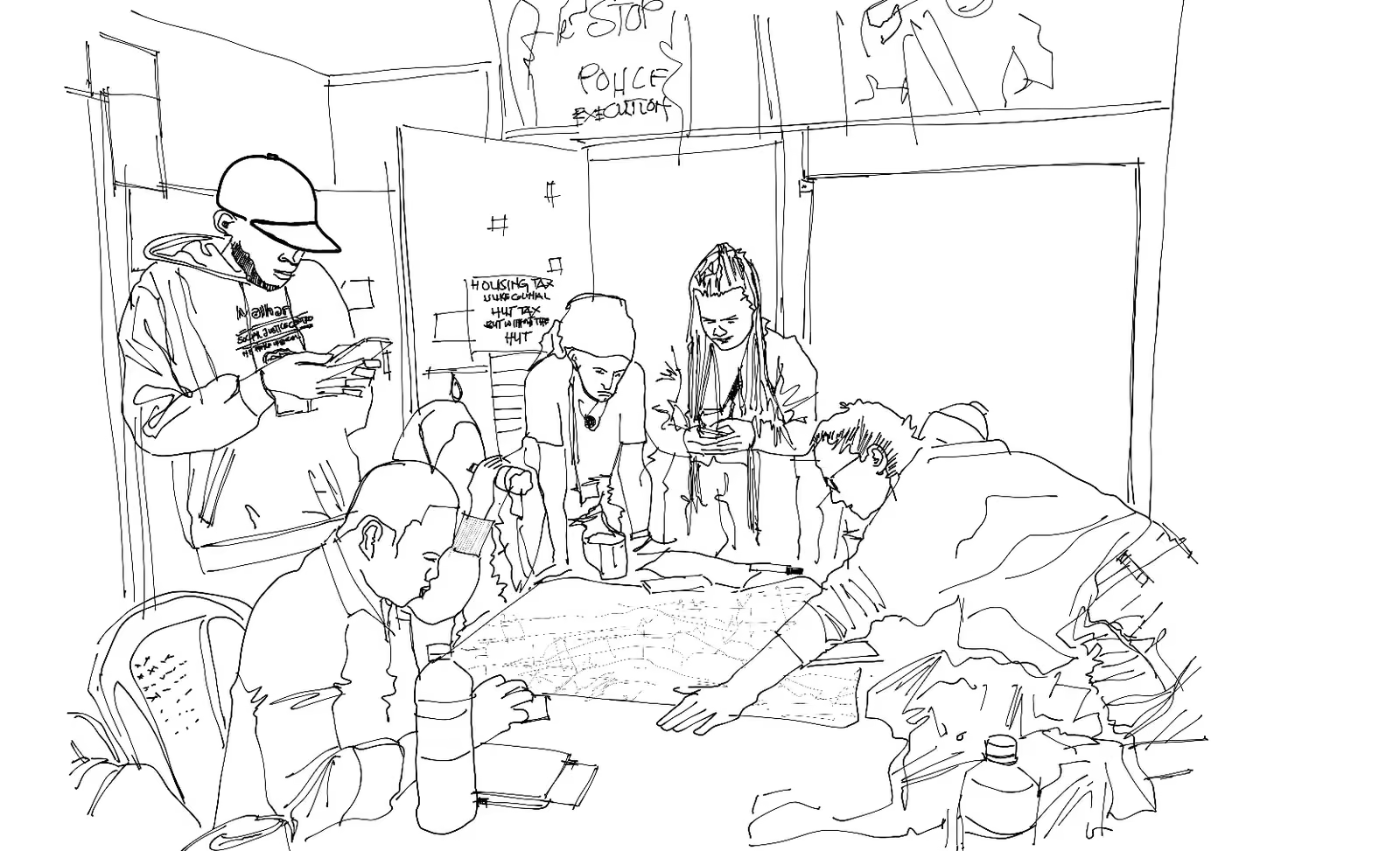
It’s 31st October, our final day of fieldwork! Today, we carried out a mapping exercise with the Mathare Social Justice Center — a community-based organization focused on human rights activism and the fight against police brutality. The goal of the exercise was to map urban farms, open parks, and other public spaces created by the CBO, in collaboration with its members and the wider community. We were joined by four members of MJS, who guided us through the sites.
These ecological interventions emerged as a response to reclaim and maintain ownership of land in the riparian zone after repeated floods and government demolitions. The urban farms serve multiple purposes — providing food for the community, offering spaces for rest and play, and commemorating loved ones lost to police brutality through tree planting and memorial gardens. They also engage the youth, steering them away from crime, while protecting open spaces from becoming illegal dumping sites.
It was truly impressive to witness what the community has achieved. We visited several farms and gardens, many of which were inspiring and innovative in their design and use.
We began our walk at Muthaiga Square, where the social divide in Nairobi becomes visibly stark. On one side, mid-rise condominium apartments stand close to the river — some still under construction — yet lacking proper infrastructure. We saw waste collectors dumping garbage directly into the river, a clear reflection of how even formal settlements contribute to pollution. These collectors, known locally as “Takataka boys,” are residents of nearby informal settlements who rely on this work for their livelihood.
Along the river, we noticed broken sewer pipes discharging into the water — including some from the Mathare National Teaching and Referral Hospital. Toxic wastewater flowed into the same river where children were playing just a few meters away. The scene was heartbreaking, a painful reminder of how infrastructure failures directly affect vulnerable communities.
From there, we walked down Muratina Street, passing through Village One, Two, Kosovo, Three A, Three B, Three C, Number Ten, Mashimoni, and ending at Mabatini. Each stop had its own story — community gardens, small farms, and creative interventions such as Green Park, Sun City Garden, Miami Florida Community Farm, and Mathare Community Park. We also mapped a few bridges built by the government.
This experience reinforced the purpose of our research — to recognize and document the extraordinary work that communities like Mathare are doing with little or no funding. Our proposal for an interactive digital map, where communities can record and update their projects, would not only create visibility but also reshape narratives. It could inspire policymakers to acknowledge these efforts and truly integrate community-led solutions into city planning.
Today was deeply eye-opening. It reminded us that real transformation starts with the people — those who refuse to give up on their communities despite all odds.
VIVA Mathare! If you know, you know.
The Wrap-Up: Connecting the Dots
Our field visit has come to an end, and here I am, trying to connect the dots. Where is Africa truly lacking? What seems to be the core problem?
One thought that keeps coming back is a comment made by Prof. Saija the night we bid her farewell as she left for Rwanda. We were discussing how Rwanda has managed to recover from the genocide and achieve so much in such a short time. What she said stood out clearly to me: “It’s impressive what the leaders have achieved, but it’s not a democracy when the majority of the people are not educated.”
That statement struck me deeply. It made me wonder—are most African countries truly democratic if the majority of their citizens are not educated?
But then, who is an “educated person”? To me, it goes beyond holding a degree or diploma. Many people have those. The real question is—does our education truly prepare us to be great thinkers? Are we capable of holding informed conversations on issues outside our professions—politics, human rights, social equity, the economy, and the environment? These are subjects that affect every one of us, whether rich or poor, literate or illiterate, young or old.
Looking back, I realize that the kind of education I received did not make me an educated person in that sense. Our school system rewards retentive memory, not critical thought. Examinations are designed to measure how much information we can recall and reproduce, not how well we can analyze, question, or innovate. There is little room for discussion, for forming our own ideologies, or for developing independent thought.
Shouldn’t we, as citizens, show interest in the matters that shape our nations? The so-called “best students” often pursue careers in medicine, engineering, or architecture, while those who study governance, social sciences, or policy are undervalued. This hierarchy of professions mirrors a colonial mindset—one that measures success by personal income rather than collective contribution to nation-building.
Isn’t this the root of corruption across Africa? We are raised to prioritize individual success over national progress. The result is a culture of greed—educated people who lack civic consciousness, who remain indifferent to social issues, and fail to hold governments accountable. We vote based on tribe or self-interest rather than integrity or competence. This is the painful truth in Ghana, where I come from, and the reality in many other African countries as well. Can we still call this democracy?
Our leaders, too, are victims of the same flawed system—driven by greed and personal gain. They negotiate foreign deals that enrich themselves rather than their people. Our foreign policies serve others more than they serve us. We must ask ourselves: is democracy inherently good just because it is Eurocentric? Where did our leaders learn their politics if not from their colonial predecessors—those who exploited and divided us?
If we truly wish to decolonize our systems, it cannot be achieved through the same education that conditioned us to think this way. We need educational reform—an education that cultivates critical thinkers, patriotic citizens, and socially responsible leaders. We should value people not by how much they earn, but by how much they contribute to national development.
Governments must be held accountable, policies must be enforced, and reforms must draw lessons from nations that have walked this path—Singapore, for example, which once faced similar challenges. If we take this seriously and work to close the social gap, the consequences of bad governance—urban slums, ethnic conflicts, hunger, and foreign exploitation—will begin to fade. We will regain control over our own affairs and serve our people better.
The need to catch up should not remain a myth. It will take time, discipline, and collective will, but it is possible. Even now, within our cities, there are glimpses of progress—pockets of comfort and innovation amidst widespread struggle. We, the privileged, have a moral duty to extend that hope to others.
We owe it to the poor in our societies—the need to catch up is not a choice; it is an obligation.
From reflection to research
A Three-Body Problem
The collaborative report brings together the fieldwork, interviews and mapping behind these reflections.
Text by Michael Mawuena Baccah. Images reproduced from the supplied learning diary. Read the original PDF for the complete slide layouts and image captions.